The new era of static analysis: AI-authored, deterministically enforced.
Author:
Mark Stuart
May 19, 2026
•3-minute read


Every engineering team has standards they believe in. Believing in them doesn't mean they get enforced.
You've seen it: a pull request derailed over a logging pattern the team agreed on months ago. A production incident traced back to a boundary violation that slipped past review. An engineer leaving the same comment again with a familiar sigh of "we've talked about this before." These aren't failures of talent. They're failures of scalability. Human review is finite; the codebase isn't.
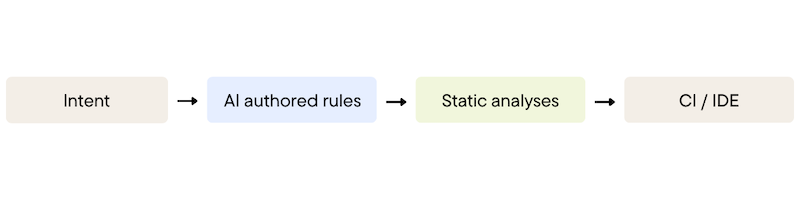
AI helps write the rules – static analysis enforces it the same way every time
What's changed isn't static analysis itself. What's changed is how easy it has become to author it. AI hasn't replaced static analysis. It has removed the hardest part: turning human decisions into executable rules. All AI-authored rules undergo peer review and testing before adoption.
The shift: from “too expensive to write” to “too valuable not to”
Every engineering organization has standards that don't come out of the box: naming conventions tied to domain models, architectural boundaries between layers, logging formats, error-handling patterns.
Historically, turning those standards into custom static analysis rules required deep knowledge of abstract syntax trees, visitor patterns, and framework-specific APIs. Most teams only invested when the pain was severe enough to justify it.
AI has changed that equation. What used to take days of specialized work can now be drafted in a focused conversation with an AI assistant. The engineer describes the intent, the AI produces a working rule, and the engineer tests, refines, and commits it.
The economics flip: Instead of asking "is this rule worth days of work," teams ask "is this standard worth enforcing." More standards get automated rather than documented. Reviewers spend less time on mechanical feedback. New team members absorb conventions through tooling, not onboarding guides. And architectural issues get caught earlier, before a boundary violation has propagated across a dozen files and become expensive to unwind.
How it works in practice
Here's a concrete example. A team identifies a logging standard: structured loggers should always receive a static string, not a dynamically interpolated one. Interpolated strings bypass structured fields, making logs harder to query and index.
An engineer describes this intent to an AI assistant. Within minutes, the AI drafts a rule that identifies calls to the structured logger, checks whether the first argument is static or interpolated, and reports a violation with a clear explanation. It also catches variable indirection, where a developer builds an interpolated string first and passes the variable to the logger later.
The engineer reviews the rule, tests it against known examples, and commits it. No AI is involved at enforcement time. The rule is code: version-controlled, peer-reviewed, and auditable.
The same approach scales to more subtle issues. During internal testing, we identified services that set recurring timers but never cleaned them up on shutdown, a potential memory leak. AI authored a rule that detects timer usage, verifies the service, implements a cleanup lifecycle method, and checks that cleanup calls exist even deep within nested control flow. What started as a test finding became an automated guardrail before it ever reached production.
Test finding. Analysis. AI-authored rule. Automated prevention. That's the pipeline.
Enforcing architecture, not just style
Modern static analysis can enforce system shape, not just code shape.
Our codebase follows a layered architecture: controllers handle incoming requests, domain services contain business logic, integration services manage external API calls, and adapters handle low-level communication. One rule reads the file path to determine which layer a file belongs to, then validates that batching logic only appears in the correct layer.
Architecture as code. Not a diagram someone has to remember, but a rule that fails the build if violated.
Why this matters
The conversation around AI in software engineering tends to focus on generation: AI writing code, tests, and documentation. But generation without governance is just faster chaos.
When clients trust us with decisions that shape their futures, the systems behind those experiences need to behave the same way every time. A logging standard ignored under deadline pressure. An architectural boundary that drifts over 6 months. These aren't just code quality issues. They erode the reliability that people depend on when navigating the most important financial decisions of their lives.
Today we maintain dozens of architectural rules comprising thousands of lines of deterministic enforcement, running in the editor, in pull requests, and in CI. Since adopting this approach, the volume of convention-based review comments has materially decreased. The question that now comes up naturally in design reviews and retrospectives: should we write a lint rule for that?
What’s next
We're thinking about what this looks like at larger scale: rule sets that enforce standards across languages, architecture-as-code libraries, shared rule registries where teams build on each other's enforcement work rather than starting from scratch.
The harder and more interesting problem is organizational memory: the hard-won knowledge of what goes wrong and why, encoded in rules that outlast any individual engineer.
AI accelerates rule authoring, but enforcement remains deterministic, version-controlled, peer-reviewed, and auditable. The combination of human judgment and machine discipline is what makes this more than a productivity improvement. It's a more honest and more scalable way to build software.

Mark Stuart
Mark Stuart is a Distinguished Engineer at Rocket leading Product Engineering with 18+ years of experience. Previously, at eBay, he was a Distinguished Engineer overseeing Payments, Identity, and company-wide developer velocity initiatives. At PayPal, he held leadership roles within the Checkout, Web Platform and Developer Experience organizations.
Related resources

3-minute read
Speed of development using AI
Discover how Rocket® leverages AI to transform every meeting into actionable insights, driving business value, productivity, and knowledge management.
Read more
5-minute read
Accelerated modernization: How AI collaboration helped Rocket transform RMO
Discover how Rocket engineers used Anthropic’s Claude Code and agentic coding principles to complete a 3-year PHP-to-Angular migration in just 4 months &n...
Read more

3-minute read
What happens when product teams and AI build together?
As AI moves from solo assistant to collaborative teammate, product teams are discovering new ways to build together. Learn how Rocket Flow connects human exp...
Read more