Meet Harry: How I built an AI digital twin of myself.
Oct 30, 2026 • 5-minute read

“Can you review this pull request for me?” It’s the kind of message I get all day as a lead engineer. But lately, some of those questions get answered before I even see them — by Harry, the AI digital twin I built of myself.
Why build a clone of yourself?
Every engineer carries an enormous amount of context in their head: requirements and how they were broken down, the reasoning behind design decisions, the state of in-flight pull requests, which production alerts matter and which are noise, and the threads connecting quality assurance (QA), product, data, and platform teams. That context is valuable, and it’s locked to one person’s availability. If I’m heads-down, in meetings, or on vacation, it goes offline with me.
I wanted to test a different idea. Instead of writing down everything I know (an impossible, always-stale task), could an AI agent learn the shape of my work directly from the places where that work already happens?
Ready to find a new career?
Browse our open opportunities today.
Meet Harry
Harry is an AI agent that lives where I work. Today, that’s our everyday workspace (email, chat, and shared documents) where Harry is built on an enterprise low-code agent platform and surfaced through the same assistant interface teammates already use. But the design isn’t tied to any one platform. Through the Model Context Protocol (MCP), the same twin can connect behind the scenes to team chat conversations, meeting transcripts, architecture diagrams, design files, code repositories, and whatever else a team’s work actually lives in. And with agent-to-agent (A2A) connections, Harry doesn’t work alone: He can hand a task to an external specialist agent (a code reviewer, a research agent, a monitoring agent) and bring the result back into the conversation. Say hello, and he’ll introduce himself as “a smarter, calmer version of you that lives in your workspace.” He mirrors the things I do daily as a lead engineer: understanding requirements and breaking them down, architecting solutions across high-level and low-level design, reviewing code and pull requests, evaluating prompts and improving machine learning (ML) workflows, monitoring production applications, collaborating with QA and product, and exploring proofs of concept for new ideas.
The key design decision is what Harry is grounded in: only my everyday work data, meaning email, chats, meetings, documents, and designs, wherever they live. Before any of it reaches the model, integrated guardrail logic filters out names, personally identifiable information (PII), and third-party data. The twin learns the shape of my work, not the people or partners in it. Everything is assembled from standard building blocks: the platform’s tools framework, MCP connectors, and A2A agent connections, with no fine-tuned model and no separate knowledge base to maintain. That constraint is exactly what makes the pattern repeatable. If it works for me, any engineer can stand up their own twin the same afternoon.
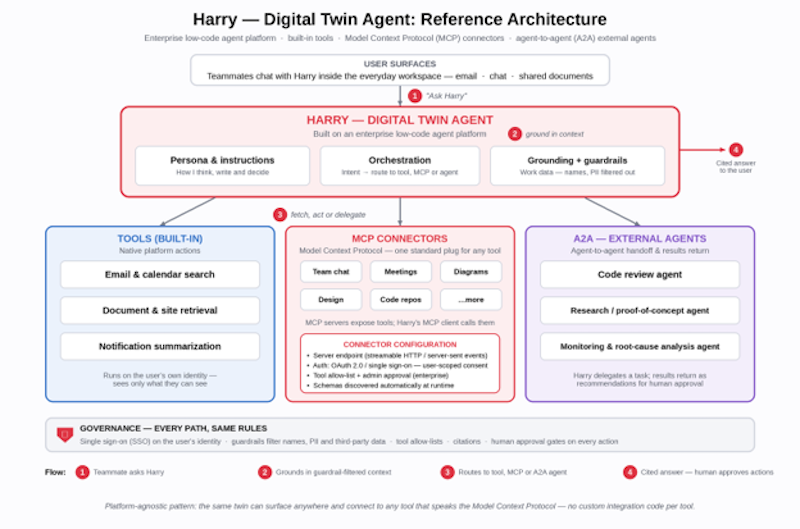
Reference architecture: how Harry routes requests across built-in tools, MCP connectors, and A2A external agents.
A day with a digital twin
My mornings used to start with inbox archaeology. Now they start with a briefing. Ask Harry what needs attention, and he turns the overnight noise into a structured summary: pull requests where I’ve been tagged for review, commits touching code I own, infrastructure notifications, and project threads that moved while I slept, each item linking back to the original message so I can verify and act. An hour of triage is now a 2-minute read.
The more interesting moments come from other people. Teammates can ask Harry to explain one of our architecture designs, and he walks through the orchestration layers, the specialized agent teams, and the supporting capabilities the way I would at a whiteboard, citing the actual design documents as he goes. New engineers can interactively explore how a lead engineer approaches requirements, testing conversations with QA, or observability practices like tracing and structured root-cause analysis. Ask him for a full “AI agent persona,” and he’ll produce a detailed breakdown of skills, collaboration patterns, and working style — assembled entirely from how I actually work, not from anything I wrote about myself.
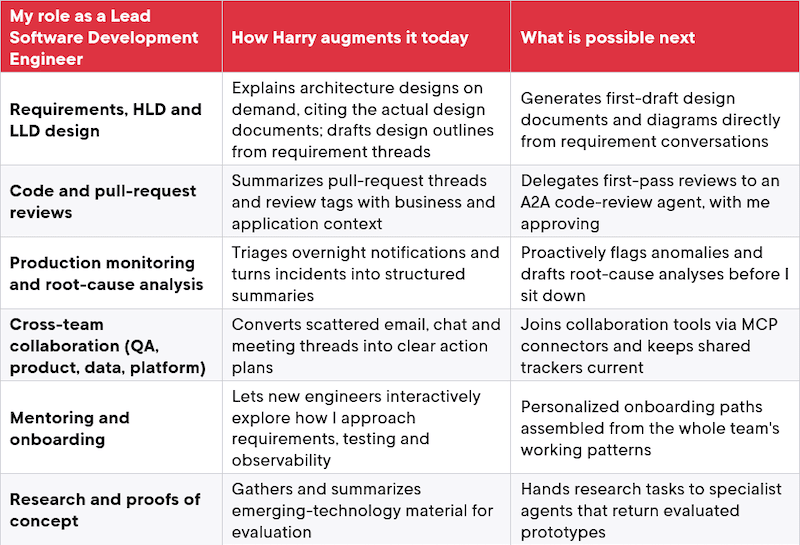
What Harry augments, today and tomorrow
Ready to apply for a position that utilizes your strengths?
The takeaway: Harry has meaningfully cut the time I spend on the routine half of this table: triage, summaries, first drafts, and status communication. That reclaimed time goes where it compounds most: learning. The technology landscape is moving fast, and the hours freed each week turn directly into time spent learning it. Just as importantly, it opens new dimensions of collaboration: deeper engagement with product teams and business units, where an engineer’s context can shape what gets built, not just how. We watch the other side of the ledger, too. Every request Harry serves logs its large language model (LLM) token consumption, and we review model spend against the hours reclaimed. The trade-off is straightforward: Harry costs a few hundred dollars to build, and single-digit dollars per morning briefing at list price. Set against an hour of triage reclaimed every morning, plus the drafting and summarization wins across a week, the trade is not close. Measuring it also taught us an engineering lesson: context, not answers, drives agent cost, so we run recurring work as fresh scheduled sessions, keep tool results tight, and start new threads per topic instead of letting one conversation grow unbounded.
What I learned
Grounding beats prompting. Almost none of Harry’s usefulness comes from clever instructions; it comes from the richness of the workspace signal he can read. The better your engineering hygiene (clear pull-request descriptions, documented designs, legible threads), the better your twin.
A twin is also a mirror. Watching an agent summarize your own work patterns back at you is an unexpectedly honest audit of where your time and attention actually go.
And trust needs boundaries — designed in from day one, not bolted on. Every action Harry drafts stops at a human approval gate: a pull-request review lands as a draft comment awaiting my sign-off, a delegated agent task comes back as a recommendation I accept or reject, and nothing posts, merges, or sends until a named human approves it. Harry cites his sources, sticks to what the workspace shows, and leaves decisions with people. A digital twin should scale your context, not your authority.
Why this matters
At Rocket, we don’t just build AI for our clients. We use it to reinvent how we work. A digital twin reduces key-person risk, accelerates onboarding, and turns one engineer’s context into a resource the whole team can query at any hour. As agentic AI becomes an industry conversation, this is what experimenting with it in real workflows looks like: small, grounded, useful — and running inside the tools we already use every day, whatever those tools happen to be.
If you could clone the way you work, what would you have your twin take off your plate first?

Related resources

3-MINUTE READ
Speed of development using AI
Discover how Rocket® leverages AI to transform every meeting into actionable insights, driving business value, productivity, and knowledge management.
5-MINUTE READ
Accelerated modernization: How AI collaboration helped Rocket transform RMO
Discover how Rocket engineers used Anthropic’s Claude Code and agentic coding principles to complete a 3-year PHP-to-Angular migration in just 4 months – modern...
3-MINUTE READ
The new era of static analysis: AI-authored, deterministically enforced.
Reduce review churn and catch issues earlier by combining AI-assisted rule creation with predictable static analysis enforcement – without relying on AI for pas...